How the Venom Mob Changed What a Martial Arts Film Could Be
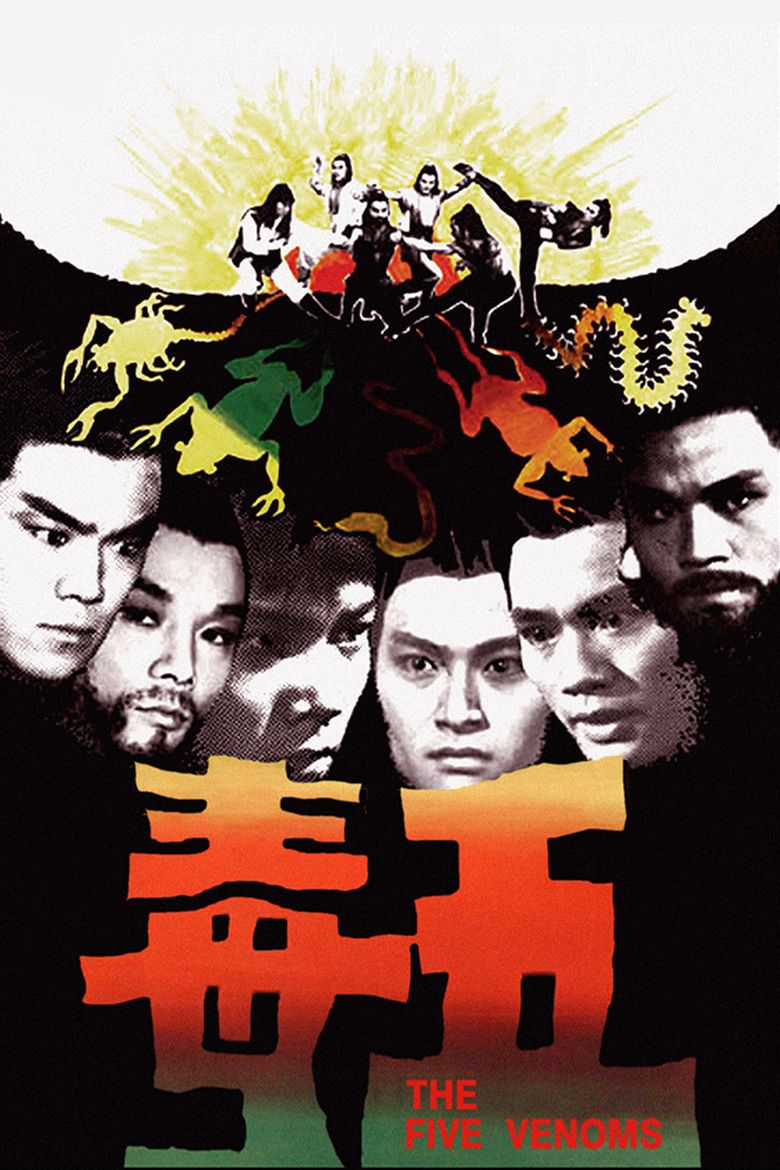
When Chang Cheh walked into a meeting with Shaw Brothers management in 1977 to pitch Five Deadly Venoms, he was the studio's most commercially successful director and he was asking for something the studio had never done. He wanted to make a martial arts film with no established star. Not a reduced star, not a supporting player elevated to the lead, not a familiar face from a previous hit. He wanted an ensemble of unknowns, performers with genuine martial arts credentials who had never carried a film, organized around a story that was as much mystery thriller as kung fu picture, in which each body in the cast represented a distinct physical system and the narrative tension came from the uncertainty of which of those systems, and which of those people, would survive to the end. Shaw Brothers resisted. Chang Cheh, who had the leverage of a decade of successful films behind him, stood his ground. The film got made.
The commercial and artistic results restructured the landscape that produced them. Five Deadly Venoms did not simply launch a group of performers. It demonstrated a principle that the martial arts film had not previously tested at this level: that an ensemble of physically gifted unknowns, each with a specific and legible skill set, could generate as much audience investment as a single established star, and could do it while telling stories that the single-star model was structurally unable to tell. The films that followed, across the next six years and roughly thirty productions, developed and refined that principle into a body of work that influenced the genre's visual language, its narrative grammar, and the way it conceptualized the relationship between individual capability and collective action. The Venom Mob did not make the single martial arts hero obsolete. They made him optional.
The six men at the center of the enterprise came from backgrounds that the Shaw Brothers model had not previously prioritized. Philip Kwok, Lu Feng, Chiang Sheng, and Sun Chien had all trained at Peking opera schools in Taiwan before being recruited by Chang Cheh, which meant they arrived with the same foundation that had produced the golden generation of Hong Kong action cinema on the other side of the industry: acrobatic vocabulary, physical expressiveness, and the specific ability to make movement legible to an audience as both technique and character. Lo Mang had been training in Southern Praying Mantis since he was thirteen and was working as an accountant at Shaw Brothers when Chang Cheh noticed him and offered him a role. The accounting background is the detail that most people who tell his story can't resist, because it encapsulates something true about how talent is distributed relative to how the industry finds it. His physical gifts were there before the industry looked. The industry just hadn't looked.
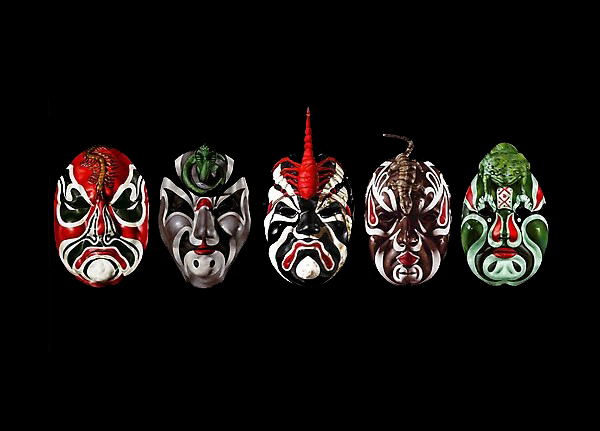
What Chang Cheh and his co-writer Ni Kuang built around these men was a structure the genre had not attempted. Five Deadly Venoms opens with a dying master instructing his last student to seek out the five pupils who came before him, each of whom has mastered one of five animal-inspired combat systems: the Centipede, the Snake, the Scorpion, the Lizard, and the Toad. The five are living in disguise somewhere in the city, their identities unknown to each other and to the audience, and the film is organized as a mystery: which of the five has turned to evil, which have remained legitimate, and how will the alliances between them resolve when the identities are finally revealed. It is a martial arts whodunit, a structure borrowed from detective fiction and applied to a genre that had previously organized its plots around simpler moral geometries. The antagonist is usually visible from early in a kung fu film, and the story's job is to build toward the confrontation. Here the antagonist is hidden, and the story's job is to locate him, which requires a different kind of pacing and a different relationship between the audience and the characters on screen.
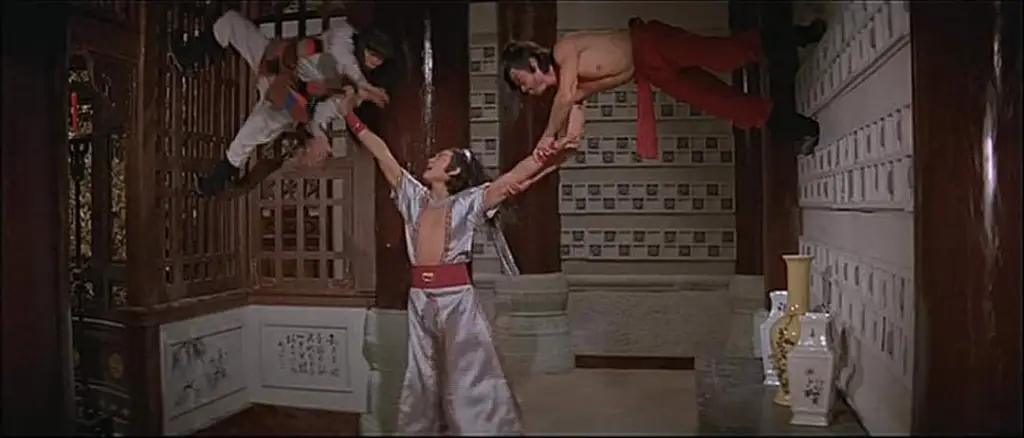
The physical design of the five styles is where the film's most lasting contribution to the genre is located. Each system is built from a genuine principle: the Centipede style emphasizes speed and multiple simultaneous strikes, the limbs operating with an insect's disregard for the conventional geometry of human movement. The Snake style works low and fluid, the practitioner moving along the ground and striking upward, the body mimicking a serpent's approach. The Scorpion fights from a defensive crouch, the strikes aimed at vulnerable points with the precision of a tail. The Lizard style is acrobatic, its practitioner capable of running up walls and fighting from vertical surfaces that conventional opponents cannot reach. The Toad style is the most physically distinctive: the practitioner hardens his body to resist damage, the skin and musculature conditioned to deflect strikes that would incapacitate anyone operating in a different system. Each style was not simply a visual conceit. Each required the performer embodying it to move in ways that the others did not, to build a physical identity from the system's internal logic rather than from a general vocabulary of screen combat.
This was new. The martial arts film before Five Deadly Venoms had generally presented fighting as individual expression: the hero's style was his character, and the diversity of styles between films reflected the diversity of the real martial arts traditions the genre was drawing from. Within a single film, styles typically served narrative function: the hero's system was proven superior to the villain's through the story's trajectory. What the Venoms cycle introduced was style as dramatic information operating simultaneously across multiple characters in the same frame, each body in the ensemble a distinct physical argument, and the narrative organized around the question of which arguments were compatible, which were opposed, and which would prove sufficient under the specific pressures the story applied. When two Venoms fought each other, it was not simply a confrontation between people. It was a confrontation between philosophies of the body, and the audience was watching to see which philosophy held.
Chang Cheh's direction served this premise with a visual approach that the genre's Western admirers have consistently undervalued relative to the choreography it contains. His crash zooms, a technique he had been using since the late 1960s and which the Venom films pushed to their most expressive extreme, were not a stylistic habit but a rhetorical device: they arrived at the moment of impact or revelation, compressing the emotional distance between the audience and the action the way a sudden shout compresses attention. His use of color was operatic, the costumes designed in saturated primaries and secondaries that gave each Venom a visual identity legible across the wide shots in which the ensemble fights were staged. The wide shots themselves were a commitment the genre was beginning to abandon in favor of coverage and closer angles, but Chang Cheh held the camera back and let the bodies fill the frame, which meant the physical capabilities of the performers were always available for evaluation rather than implied through editing.
The individual members of the ensemble developed distinct screen identities across the cycle that the first film had only sketched. Philip Kwok, who had the broadest range of the group, became the cycle's most versatile performer: capable of comedy, tragedy, and the particular register of cheerful competence that the best kung fu films require of their heroes, he was also the group's most sophisticated fight choreographer, and his staging work on several of the later Venom films reveals an intelligence about spatial dynamics and physical storytelling that would eventually take him into the mainstream of Hong Kong action cinema's next phase. His role as Mad Dog in John Woo's Hard Boiled (1992) is, for many Western viewers, the first time they encountered him without knowing they already had, which is a reasonable summary of his whole career: present in the work, credited in the titles, underidentified in the cultural record.
Chiang Sheng was the acrobatic peak of the ensemble, the performer whose movement was closest to the Peking opera tradition in its most elaborated form. He could do things in a sustained take that most action choreographers were designing around the edit: mid-air direction changes, weapon transitions executed at speed, the kind of spatial improvisation that the opera school trained into the body rather than programming as a sequence. His contribution to the visual spectacle of the Venom films was disproportionate to his name recognition outside the dedicated audience, which is a pattern the ensemble format produces structurally: the most distinctive contributors are often the ones whose specific gifts are hardest to summarize in a marketing context.
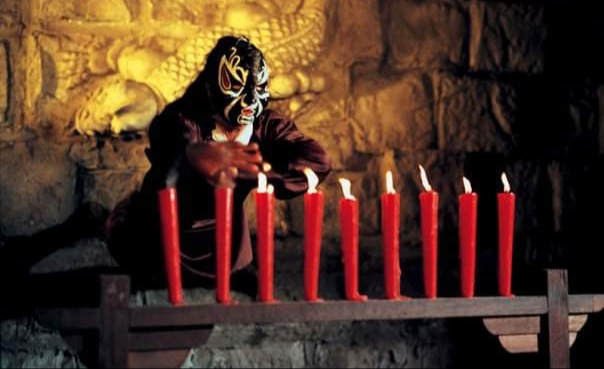
Lo Mang's physical presence operated in a different register. Where the rest of the ensemble was organized around speed and acrobatic precision, Lo Mang was organized around mass and resistance, the Toad style's philosophy made literal in a body that could absorb punishment that would end anyone else's fight and keep moving. Chang Cheh used this with specific intelligence: Lo Mang was frequently the first major character to die in a Venom film, and the deaths registered as meaningful precisely because of what they were eliminating. When the most physically formidable body in the ensemble stops functioning, the stakes of what follows become real in a way that the removal of a weaker character cannot produce. He was the ensemble's structural anchor, the weight against which everything else was measured.
The Venom cycle's influence on the genre radiates outward in ways that are easy to trace once you know where to look. The ensemble action film, which the Western action cinema of the 1980s was simultaneously developing through a completely different tradition, found in the Venom films a more sophisticated model than most Hollywood ensemble pictures were producing, because the Venom films had worked out the specific problem of how to give multiple physically distinctive performers narrative space without the film losing coherence or forward momentum. The answer they arrived at, which was to build the story around the relationships between the styles rather than the biography of any individual practitioner, is still the most elegant solution anyone has found to the problem of the action ensemble.
Quentin Tarantino's Kill Bill is the most cited downstream evidence, and the citation is accurate: the Deadly Viper Assassination Squad, five assassins with distinct physical specializations operating in a story organized around betrayal and the revelation of hidden identities, is a direct structural borrowing from the Venom cycle. The animal motif, which Kill Bill transposes from styles into code names, carries the same function. What the film's admirers sometimes miss is that Tarantino wasn't simply taking the surface. He was taking the argument: that a story about five skilled bodies with different philosophies of violence, arrayed against each other through betrayal, is more interesting than a story about one skilled body against an undifferentiated opposition.
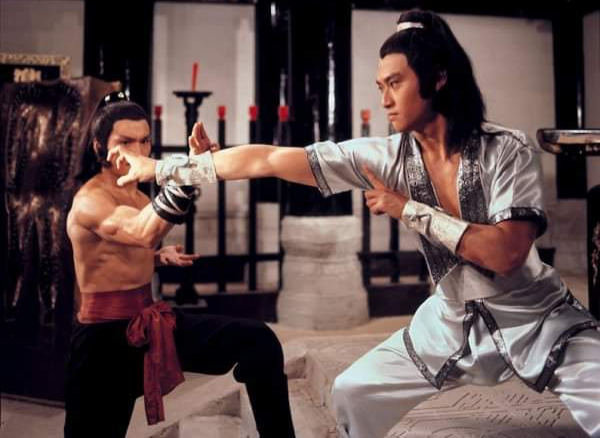
The personal histories of the Venom Mob members after the cycle ended are uneven in ways that the ensemble format's specific commercial logic helps explain. The group's identity was constructed collectively, which meant that the transition to individual careers required each performer to establish a solo commercial proposition that the ensemble had never needed to generate. Some managed it: Philip Kwok built a long career as a choreographer that extended his influence well past the Shaw Brothers era. Lo Mang worked consistently in Hong Kong film and television for decades, his later appearance in the Ip Man films as a formidable elder practitioner arriving as a kind of genre acknowledgment of the career that preceded it. Others did not make the transition. Chiang Sheng returned to Taiwan when the ensemble dissolved, found limited work in an industry that had moved on from the idiom he had mastered, divorced, fell into depression, and was found dead in his apartment in August 1991 at forty years old. His old colleague Philip Kwok said, simply, that it was more of a broken heart than anything physical. The Venom cycle had given him the context in which his specific gifts made sense, and when the context dissolved, the gifts had nowhere to go.
The films are still there and they still work. What they require is a willingness to watch fights as arguments rather than spectacle, to track the physical logic of five distinct systems as they collide and combine and eliminate each other, and to understand that the moral questions Chang Cheh was always asking, about loyalty and betrayal and the specific kind of integrity that lives or dies in the body rather than in the mind, are answered here through movement rather than dialogue. The Venom Mob did not change martial arts movies by making them more spectacular, though the films are spectacular. They changed them by demonstrating that the body in motion could be a narrative instrument sophisticated enough to carry a mystery, to sustain a moral argument, and to make five unknowns worth watching as carefully as any established star.
Shaw Brothers had never done it before. Nobody has quite done it the same way since.