The question that gets asked about gun-fu, when it gets asked at all, is usually some version of “where did this come from?” The answer most people are satisfied with is John Woo, A Better Tomorrow, 1986, and they move on. That answer is correct as far as it goes, which is not very far. It identifies the moment of ignition without explaining the conditions that made ignition possible, which is the more interesting question. Woo did not invent a genre from nothing. He translated a set of values, a moral vocabulary about brotherhood and loyalty and the cost of violence, that had been encoded in Hong Kong action cinema for two decades, from one physical language into another. The sword became a gun. The wandering swordsman became the urban hitman. The wuxia hero’s code of honor became the triad’s yi, the brotherhood bond that structured the heroic bloodshed film. None of that happened by accident, and it didn’t happen because John Woo woke up one morning and decided gunfights would be more cinematic than swordplay. It happened because Hong Kong in the 1980s was a society with specific anxieties about modernity and the future, and the action cinema it produced was a direct expression of those anxieties, translated into the idiom that those anxieties demanded.
To understand why the shift happened, you have to start significantly earlier than 1986, with the tradition being replaced.
The wuxia genre, that body of swordplay films built around wandering knights, ancient codes of chivalry, and superhuman martial arts performed with the wire and the imagination, is one of the oldest continuous traditions in Chinese popular culture. It began as a literary form in the early twentieth century, was suppressed in mainland China for promoting what the government called superstition and feudalism, and migrated to Hong Kong, where Shanghai filmmakers had fled during and after the revolution. Shaw Brothers Studio, the dominant production house of the 1960s and early 1970s, built much of its commercial empire on wuxia: swordplay films set in dynastic China, populated by warrior heroes operating under codes of conduct that predated any recognizable modernity, in a visual world of period costumes and elaborate martial choreography that was explicitly fantastic. The geography of the wuxia film is a kind of moral landscape: the jianghu, the world of the rivers and lakes, is a space outside ordinary society where the rules of ordinary society do not apply and where personal honor is the only currency that matters. The swordsman in this tradition is defined by his rootlessness. He travels, he does not belong to the places he passes through, and his allegiances are to individuals and to codes rather than to institutions or governments. What he carries, the sword, is both a weapon and a symbol: the external expression of an internal condition, the sharpened edge of a way of life.
Chang Cheh, who spent two decades at Shaw Brothers and whom people in the industry call the godfather of Hong Kong cinema without much argument, was the director who most systematically explored what the wuxia tradition was actually about beneath its period surface. His films, from The One-Armed Swordsman (1967) through the Venom Mob pictures of the late 1970s, were obsessed with a particular cluster of themes: male friendship as the highest form of loyalty, violence as sacrifice, the body as the site where honor is demonstrated and ultimately spent. His heroes died in baroque, slow-motion set pieces, bleeding out on the screen in postures that registered as operatic rather than merely gruesome. The violence was expressive. It was making an argument. Chang Cheh was not simply staging fights. He was building a moral grammar, and the grammar he built was not about swords specifically. It was about the values the swords represented, and those values, as it turned out, translated with remarkable fidelity to the next physical language the cinema reached for.
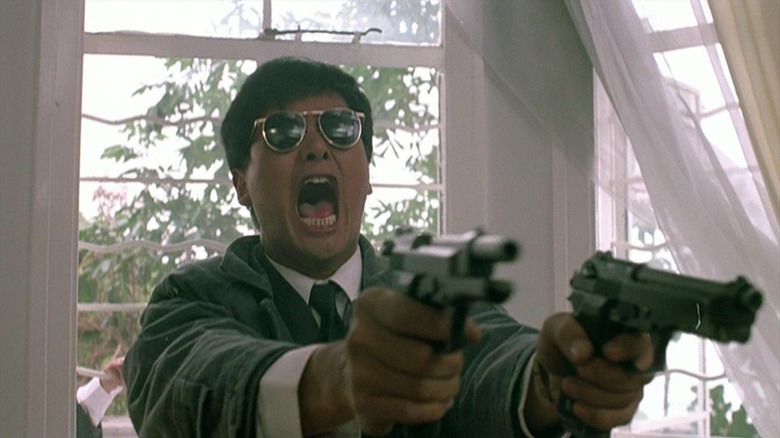
John Woo worked as an assistant director under Chang Cheh in the 1970s, and he has been explicit about the debt in interviews spanning his entire career. When he made A Better Tomorrow in 1986, he was not departing from the tradition he had learned in. He was updating it. The wandering swordsman became Chow Yun-fat’s Mark Gor, a triad enforcer in a trenchcoat with a toothpick between his teeth and two pistols in his hands. The jianghu became the neon-lit streets of contemporary Hong Kong. The code of the xia became the yi of the criminal brotherhood. The sword became the gun. Every element of the moral grammar Chang Cheh had built was present and operational. What had changed was only the setting, and the setting changed for reasons that had very little to do with aesthetics.
The timing of the shift is the crucial thing to understand. The mid-1980s in Hong Kong was a period of deep collective anxiety that had a specific trigger date. In 1982, Margaret Thatcher visited Beijing to negotiate the future of Hong Kong, and the negotiations made clear what many people had already suspected: the colony would be returned to Chinese rule in 1997, and there was no realistic possibility of any other outcome. The Sino-British Joint Declaration was signed in 1984. The people of Hong Kong had thirteen years to process the fact that a way of life they had built, a specific urban modernity that was economically successful and culturally distinct and politically different from anything in mainland China, was going to be absorbed into a system whose values it did not share. The Tiananmen Square massacre of 1989, in which the Chinese government’s response to student demonstrations was to send in tanks, deepened the anxiety into something closer to dread.
Hong Kong cinema in the 1980s was saturated with this. Not always explicitly, rarely directly, usually through the displacement that genre always provides: put a thing in a genre context and you can say things about it that straight address would not permit. The wuxia tradition, with its rootless wanderers operating outside stable institutions in a world that was always already passing away, had always been available as a vehicle for displaced anxiety about identity and belonging. But the wuxia tradition was set in the past. It offered elegance and myth and the comfort of historical distance. What the 1980s required was something that looked like now, something set in the actual streets of the actual city, because the dread was not abstract and historical. It was specific and contemporary and arriving on a fixed schedule.
The heroic bloodshed film provided exactly this. Its world was recognizable: high-rise apartments, harbor views, police precincts, restaurants, hospitals. Its protagonists were urban professionals, criminals and cops whose conflicts were conducted in the present tense. And the gun was the weapon of the present tense in a way that the sword, however beautiful its choreography, could never be. A sword is an anachronism in a modern city. A gun is not. The gun says: this is happening now, to people like you, in a place you recognize. The swordsman’s code of the jianghu, transposed onto the triad brotherhood, said: the same values that structured the old moral world still operate, even here, even now, even under these conditions. That combination of present-tense urgency and ancient moral weight was exactly what the cultural moment required, and Woo intuited it with the instincts of a filmmaker who had spent years absorbing the tradition he was translating.
The specific visual language he developed to express it was not arbitrary either. The slow motion, the simultaneous dual-wielding of pistols, the acrobatic dives and spins, the way bodies moved through space in a sustained choreographic arc rather than simply falling when shot: all of this was drawn directly from the physical grammar of the wuxia and kung fu films that preceded it. The gun-fu fight is structured like a swordplay fight. It has an economy and a geometry that martial arts choreography trained Hong Kong audiences to read. When Chow Yun-fat slides across a table in The Killer (1989) and comes up firing with both hands, that movement is legible as a martial arts movement. The physics are wrong for a realistic gunfight, which nobody is pretending this is, but the physics are exactly right for a movie fight staged in the tradition of swordplay choreography. What changed was the weapon. The underlying language of how bodies moved in conflict, what that movement was supposed to mean, how the camera was supposed to hold it, all of that was continuous with what came before.
Before A Better Tomorrow, the critical consensus on gun play in Hong Kong cinema was that it was dramatically inert compared to the martial arts. The reasoning was straightforward: guns require no training that reads on screen. A person who cannot fight can fire a gun, and the gun does the same thing regardless of who is holding it. The whole premise of the martial arts film is that physical capability is personal, that it belongs to the body of the person performing it, that you can see the years of training in the movement. A gun democratizes violence in a way that a sword or a fist does not. Woo’s insight was that you could restore that sense of personal investment by choreographing the gunfight the way you choreographed a martial arts fight: as a sustained physical performance, demanding of the body, legible as craft, expressive of character. Mark Gor doesn’t just shoot people. He moves through a gunfight the way a dancer moves through a routine, and the specific quality of the movement says something about who he is and what he believes. The gun became personal again because the body using it was performing, not just operating a mechanism.
The commercial results validated the insight immediately. A Better Tomorrow broke box office records in Hong Kong on release. Chow Yun-fat, who had been a successful television actor largely working in comedies and melodramas, became overnight the biggest star in the colony’s cinema. Audiences were responding to something they recognized and something they needed simultaneously: the ancient moral grammar of the wuxia tradition in a contemporary form that addressed the anxieties of the present. Ringo Lam followed with City on Fire (1987), which pushed the genre toward a more realistic and bleaker register. Tsui Hark, who had produced A Better Tomorrow, expanded his involvement in the heroic bloodshed idiom. The genre proliferated rapidly because the cultural conditions that produced it were shared across the entire industry, not specific to Woo.
Hard Boiled (1992) is where the formal ambition of the genre reached its peak, and it is worth lingering there because it represents the most complete translation of wuxia values into gun-fu language. The hospital sequence that closes the film, a sustained action set piece running close to half an hour, is shot with the spatial coherence and choreographic clarity that serious swordplay cinema had always aspired to. Woo keeps the geography legible throughout, which in a sequence of that scale, involving that many bodies, is a genuine technical achievement. The sequence moves through the hospital the way a wuxia hero moves through a fortress: systematically, purposefully, with a moral logic that structures the violence rather than merely propelling it. Chow Yun-fat carries an infant through the gunfire for part of the sequence, and the image, an armed man navigating pure chaos while protecting absolute innocence, is a wuxia image in contemporary clothes. It reaches for the same emotional register that the great swordplay films were reaching for. It arrives.
The Western spread of gun-fu is a separate story from its Hong Kong origins, but they are connected by the specific mechanism of the VHS tape and the specific person of Quentin Tarantino. In 1992, at the Toronto International Film Festival press conference for Reservoir Dogs, Tarantino named John Woo and Hong Kong cinema as central influences. What Tarantino said at that press conference sent a wave of Western film enthusiasts backward into a decade of Hong Kong cinema they had mostly missed, through bootleg tapes and gray-market Chinatown video stores and the then-nascent internet. Robert Rodriguez had arrived at similar influences independently, and his El Mariachi (1992) and Desperado (1995) transplanted the heroic bloodshed grammar into a Mexican border context with enough fidelity that the lineage was unmistakable. Luc Besson channeled elements of it in Leon (1994). The Wachowskis absorbed it wholesale for The Matrix (1999), where the lobby shootout sequence is practically a textbook demonstration of Woo’s visual vocabulary, down to the trenchcoats and the dual pistols and the slow-motion dive.
What the Western films took from Hong Kong, almost universally, was the visual surface: the choreographic logic of the gunfight, the slow motion, the geometric elegance of bodies in coordinated violent motion. What they mostly left behind was the moral weight. The heroic bloodshed genre at its best was not primarily about the spectacle of gunfights. It was about honor and betrayal and the cost of loyalty in a world where institutions couldn’t be trusted and the only reliable unit of value was the individual bond between people who had chosen each other. That content was produced by a specific historical and cultural context, Hong Kong in the 1980s with 1997 on the horizon, and it did not travel with the same fidelity as the form it inhabited. Tarantino came closest to capturing it, because Tarantino was interested in the moral grammar as well as the choreography, in what the violence meant as well as how it looked. Reservoir Dogs is about loyalty and its limits, about what happens when the code of the criminal brotherhood encounters a reality that the code is not equipped to handle. That is a heroic bloodshed question. The surface was borrowed from Ringo Lam. The question was borrowed from the tradition Lam and Woo had inherited from Chang Cheh and the wuxia cinema before him.
The irony of the Western absorption is that it helped accelerate the decline of the Hong Kong original at the precise moment the original was being most widely celebrated. Woo himself moved to Hollywood in 1993, where he made films of variable quality that retained his visual signature while operating in a commercial environment that did not share the cultural conditions that had produced it. Chow Yun-fat followed, and spent a decade in Hollywood films that never quite knew what to do with him. The talent exodus that accompanied the approach of 1997 was real and significant: Hong Kong filmmakers who had spent the 1980s producing the most vital action cinema in the world were heading for the exits, and what they left behind was an industry trying to replicate a formula whose animating energy had departed with its originators.
The gun-fu style did not disappear. It mutated, absorbed into the global action cinema vocabulary in ways that made its Hong Kong origins invisible to most audiences encountering it. John Wick (2014) and its sequels are the most recent significant expression of the lineage, and they are conscious of it in ways that the franchise’s more casual viewers are not: the choreographic precision, the emphasis on the personal physical credential of the protagonist, the moral framework built around codes of conduct in a criminal underworld, all of it runs back through Woo and Lam to Chang Cheh and the swordplay tradition those directors inherited and updated. The gun is still doing the sword’s work. The jianghu has become the Continental Hotel. The ancient codes are still operating, even here, even now, even under these conditions.
What the shift from swordplay to gun-fu ultimately demonstrated is something that people who think seriously about action cinema as a form have always known: the weapon is never really the point. The weapon is a vehicle for the values the genre is organized around, and when those values find a new vehicle that speaks more directly to the anxieties of the present, the genre migrates. The wuxia tradition did not die when the gun replaced the sword. It adapted, the way traditions that have genuine vitality always adapt, by finding the contemporary form that carries the ancient content forward. The swordsman’s code survived the transition into the hitman’s trenchcoat because the code was never about the sword. It was about the question the sword was asking. And that question, about loyalty and honor and what a person owes the people they have chosen and what happens when the world makes honoring those debts impossible, is not going away anytime soon. It will find whatever weapon the present tense makes available, and it will use that weapon to ask the same thing it has always been asking. The form changes. The argument doesn’t.