Lost in Translation
The first thing to establish is that karate and kung fu are not competing systems. They are not, at the level of technical reality, rivals. Karate is a Ryukyuan and Japanese martial tradition, developed in Okinawa, refined through Japanese systematization, and organized around a philosophy of striking, blocking, and kata practice that reflects its specific cultural and pedagogical origins. Kung fu is a broad term covering hundreds of distinct Chinese martial arts systems, many with histories spanning centuries, all reflecting the philosophical, geographic, and practical conditions that produced them. The two traditions overlap in certain technical areas, diverge in others, and are in most respects simply different responses to different questions. Practitioners who have trained seriously in either or both understand this without needing it explained.
American pop culture has never understood it, and never particularly wanted to. What American pop culture did with both traditions, across roughly five decades of engagement, tells you considerably more about American culture than it does about karate or kung fu. The screen versions of both arts are essentially inventions, constructed from real source material but organized around American anxieties and American desires that had nothing to do with Okinawa or the Shaolin Temple or any actual dojo or training hall. The rivalry that pop culture insisted on between them was a product of the way American entertainment processes foreign things: by reducing them to a legible binary, a this-or-that that can be argued about and identified with and marketed. The actual relationship between the two traditions, which is complex, historically intertwined, and mostly cooperative among serious practitioners, was commercial dead weight. The invented rivalry was not.
The sequence matters. Kung fu arrived in American popular consciousness first, and it arrived with the specific force of Bruce Lee’s persona behind it, which meant it arrived as something foreign and dangerous and impossible to fully domesticate. Lee was not making concessions to American comfort. His films, even the ones made with Hollywood money and for international distribution, were organized around a set of values that were specifically Chinese and specifically anticolonial: the protagonist resisting occupation, standing against the contempt of a dominant culture that had decided his people were weak, winning not through submission to the system but through the superiority of his own physical tradition. Fist of Fury, in which Lee plays a student of the real historical martial artist Huo Yuanjia and destroys a sign reading “No Dogs and Chinese Allowed,” is not subtle about this. Neither is the fact that he defeats Japanese and Russian opponents with Chinese technique. The political content was not incidental to the commercial appeal. It was the commercial appeal, legible across cultural lines to anyone who had ever been told their tradition didn’t count.
Karate’s route into American pop culture was slower and came through a completely different channel. American servicemen stationed in Japan and Korea during and after the Second World War and the Korean conflict had returned home with martial arts training, and through the 1950s and 1960s a small but serious American karate community had been building, producing practitioners who were competing and winning at international levels. Chuck Norris, who received his Tang Soo Do black belt while serving in the Air Force in South Korea, was part of this cohort. The first American karate dojo opened in Los Angeles in 1955. Ed Parker, a Hawaiian-born practitioner who developed his own system called American Kenpo, established a tournament circuit that became the infrastructure through which American sport karate developed its own distinct character. By the time the Hong Kong films were arriving in American theaters in the early 1970s, karate had a domestic institutional presence, with schools, tournament circuits, and credentialed American practitioners who had earned their ranks through genuine training.
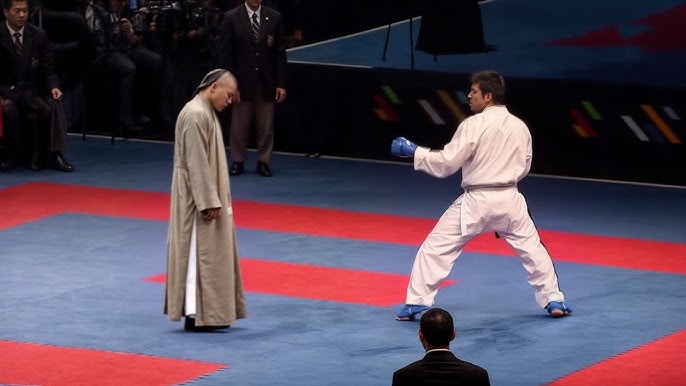
The commercial tension between the two, in the American popular mind, began with a single fight scene. Way of the Dragon (1972), Bruce Lee’s self-directed film in which he played a Hong Kong man defending a Chinese restaurant in Rome from organized crime, built to a climactic fight in the Colosseum against a character played by Chuck Norris, at the time the reigning American karate champion. The fight was staged as a genuine crosstradition contest: Lee’s Jeet Kune Do, his own synthesis that drew from Wing Chun, boxing, fencing, and whatever else he found useful, against Norris’s Tang Soo Do and Karate. It is one of the great fights in martial arts cinema for the simple reason that both men were genuinely skilled and both performances reflected that skill in ways that cannot be faked. Lee wins, which is both narratively and commercially inevitable, but the fight is close enough and Norris impressive enough that the outcome doesn’t read as dismissal. It reads as a genuine reckoning between two traditions, conducted at the highest available level.
What the American industry took from that fight was not the nuance. It took the binary. Chinese kung fu versus Japanese karate, East versus East, an argument about which tradition was better that American audiences could engage with as spectators without having trained in either. The argument was artificial, as most pop culture rivalries are, but it was durable, and it organized a significant amount of the entertainment product that followed. Norris’s career through the late 1970s was built on the karate side of the binary, explicitly: he was the American karate champion, the man Bruce Lee had fought, and his subsequent films positioned him as the domestic answer to the Hong Kong imports. His Missing in Action series and the Delta Force films were not martial arts films in any serious sense, but they carried the credential of a man who had genuine karate training and genuine competition results, and the audience understood the distinction between that and the untrained actors who were also appearing in action films of the period.
The turn that defined everything that followed came in 1984, when The Karate Kid arrived and became one of the highest-grossing films of the year. It is not possible to overstate how much this film reorganized the pop culture relationship between the two traditions, and it is not possible to fully understand what it did without understanding what it was doing at the level of cultural translation. The film took the training narrative that had been the dominant structure of Hong Kong martial arts cinema since the late 1970s, the student who submits to eccentric instruction and emerges transformed, and relocated it into a completely American suburban context with a Japanese teacher and a tournament structure borrowed from American sport karate. What the film called karate bore no systematic relationship to any actual karate tradition. The techniques were primarily Tang Soo Do, the training methodology was invented for the screenplay, the philosophy was a synthesis of hippy counterculture, the Kung Fu television series, and whatever the screenwriter Robert Mark Kamen had absorbed from his own Okinawan Goju-ryu instruction. Pat Morita, who plays Mr. Miyagi and who is Japanese American, had to audition twice because the first time he used his natural American accent and didn’t read as sufficiently exotic. He returned with a thick Japanese accent and sentence constructions that the film’s academic critics have accurately identified as the “oriental monk” stereotype. That version got the part.
The film’s success, which was genuine and commercially significant, did something that the Hong Kong imports had not managed: it made martial arts a family product. The Shaw Brothers films and the Kung Fu Theater Saturday block had always carried the whiff of the disreputable, the grindhouse, the Saturday afternoon slot that parents tolerated rather than endorsed. The Karate Kid played to middle America, received a PG rating, and was directed by the man who had made Rocky. The narrative template was sports underdog rather than foreign avenger, and the discipline on screen was presented as character-building rather than dangerous. The film produced a karate school enrollment surge across the country that the industry has never seen replicated by any other single film. Children who watched Daniel LaRusso win a tournament with a technique that no legitimate karate practitioner would recognize went to their local strip mall dojos and signed up for lessons the following week, and the instructors waiting for them were generally not people who could have explained the difference between what they taught and what they had just seen on screen.
What the domestication of karate produced, in practical terms, was the belt factory system, and this is where the divergence from kung fu became functionally significant. Karate’s ranked belt system, inherited from Judo and formalized through Japanese systematization, was commercially legible in a way that kung fu was not. You could tell where you were. You could show your parents and your friends and your employer that you had achieved something measurable. The colored belt visible under the uniform told a story that the graduation certificates of many Chinese martial arts schools did not tell in the same immediate visual language. American parents, signing their children up for after-school activities, responded to the belt system the way American parents respond to most graduated achievement structures: they enrolled their children and paid for the lessons and celebrated the promotions. Kung fu schools, which generally operated on a longer timeline with less visible intermediate milestones, competed for the same market with a product that was harder to package and harder to sell to people whose primary motivation was a structured extracurricular rather than a serious martial education.
Chuck Norris understood the commercial logic of this before most of his contemporaries, and he used it. His Kick Dru.gs Out of America program, launched in the early 1980s and operating through the karate school network, was a genuine public service initiative that also functioned as a distribution channel for the martial arts school industry. He was not wrong that the disciplined structure of traditional karate instruction offered something real to children in at-risk communities. He was also not wrong that the belt system’s visible progression was a useful tool for maintaining enrollment. The marriage of genuine social purpose and commercial savvy that Norris represented was karate’s commercial highwater mark in America, and it produced a generation of American practitioners who were trained to varying degrees of seriousness in a version of karate that was already several removes from its Okinawan source.