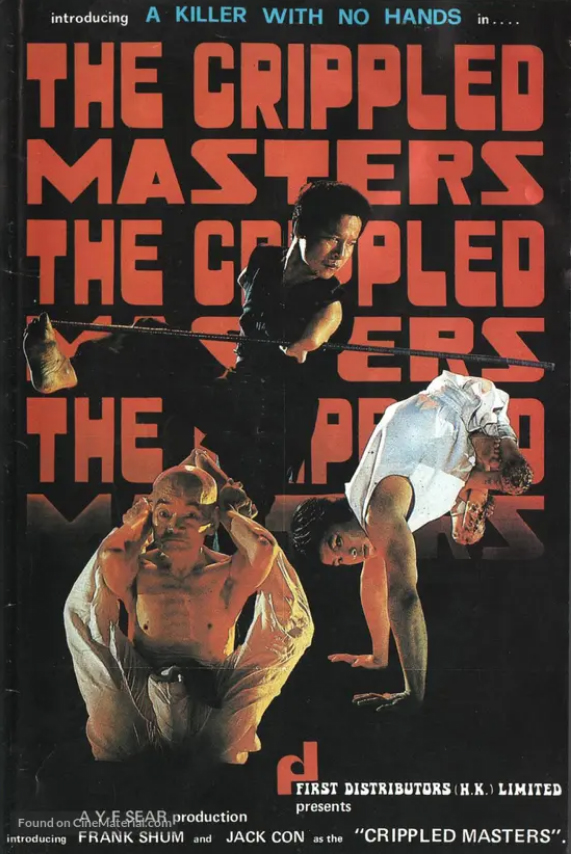
Let's establish terms first, because this title gets confused with another film from this series' orbit. Crippled Avengers is the 1978 Shaw Brothers picture where Chang Cheh's Venom Mob acted disabilities with prosthetics and choreography. The Crippled Masters, from 1979, is something else entirely: a low-budget Taiwanese production starring two genuinely disabled martial artists, one born with only vestigial arms, the other with legs that don't support him, doing real kung fu on camera with no tricks, no doubles, and no special effects budget that could have faked any of it anyway. It is one of the strangest films ever to circulate in the West, it lives in every public-domain DVD bargain bin and "weirdest movies ever" listicle, and it deserves a far more serious conversation than it usually gets. So let's have one.
The plot is revenge boilerplate with a brutal opening. A kung fu boss punishes one henchman by having his arms severed and another by destroying his legs with acid, discarding both men as worthless. The two outcasts find each other, initially with hostility, then find an eccentric old master who trains them to fight as a complementary unit, the armless man's legs and iron-hard upper body paired with the legless man's powerful arms and ground mobility, eventually combining quite literally, one mounted on the other's back, into a single two-man fighting system that comes for the boss. As story engineering, it's the disabled-fighter subgenre that One-Armed Swordsman founded, pushed to its logical extreme: not one compensating fighter but two, whose styles only complete each other.
Now the part that matters, the action, assessed honestly. The two leads, billed in Western prints as Frankie Shum and Jackie Conn, are legitimately remarkable physical performers. Shum fights with his legs, feet, shoulders, and torso, manipulating weapons and props with his feet, taking falls and rolling without arms to catch himself, which anyone who has ever practiced breakfalls will recognize as genuinely difficult and genuinely dangerous. Conn moves entirely on his hands with the upper-body power of a gymnast, striking from ground positions, climbing, and absorbing choreography that able-bodied stunt performers would feel in the morning. The fight design around them is inventive in ways necessity always produces: low-line attacks, unusual ranges, grappling configurations no other film has reasons to explore. The filmmaking around the fights is crude, flat coverage, rough editing, day-rate everything, but the physical content is authentic and frequently jaw-dropping. These two men are not the joke some midnight audiences took them for. They're athletes, full stop.
Which brings us to the conversation the film forces, because there's no reviewing this honestly without it. The Crippled Masters is an exploitation picture. Its framing, starting with that title, sells disability as spectacle, the opening mutilations are staged for shock, and the production clearly understood its marketing hook was the bodies of its stars. And yet, the film spends its runtime doing something the exploitation frame doesn't fully contain: it presents two disabled men as the most capable people on screen, training, strategizing, and winning, while every able-bodied villain underestimates them to his immediate regret. Disabled performers then and now get almost no opportunities as action leads, and these two carry an entire feature. I've gone back and forth over the years, and where I've landed is that both things are true at once. The packaging is exploitative. The performances are empowering. Pretending either half away flattens a genuinely complicated artifact.
Historically, the film sits in a specific ecosystem worth mapping. By 1979 the Taiwanese independent kung fu industry was churning out quick productions in the shadow of Hong Kong's studios, chasing trends, and the disabled-fighter cycle was hot: Shaw's Crippled Avengers had just demonstrated the premise's box office appeal, and this film arrives as the down-market, real-bodies answer to it. Its Western afterlife is its own story, falling into public domain limbo, getting packaged into grindhouse and mall-store DVD compilations, screening at midnight shows, and eventually circulating online, where each generation rediscovers it, gawks, and then, if they keep watching, comes around to respect. That arc, mockery curdling into admiration, has happened to nearly everyone I know who's seen it, and I think it's the film's actual legacy.
So how to score something like this? As filmmaking, it's a two-star production on its best day, cheap, clumsy, and tonally all over the road. As a physical document, it's singular, two performers doing things no other film in history shows, and as a cultural object it's a genuinely useful provocation about who gets to be an action hero and on what terms. I'll call it three stars with an asterisk the size of the screen, and a viewing instruction that matters more than the number: watch it straight, not ironically. Skip the riff-track impulse, watch what Shum and Conn are actually doing with their bodies, and you'll come out the other side the way I did, slightly ashamed of your first instinct and completely sure you witnessed something real.