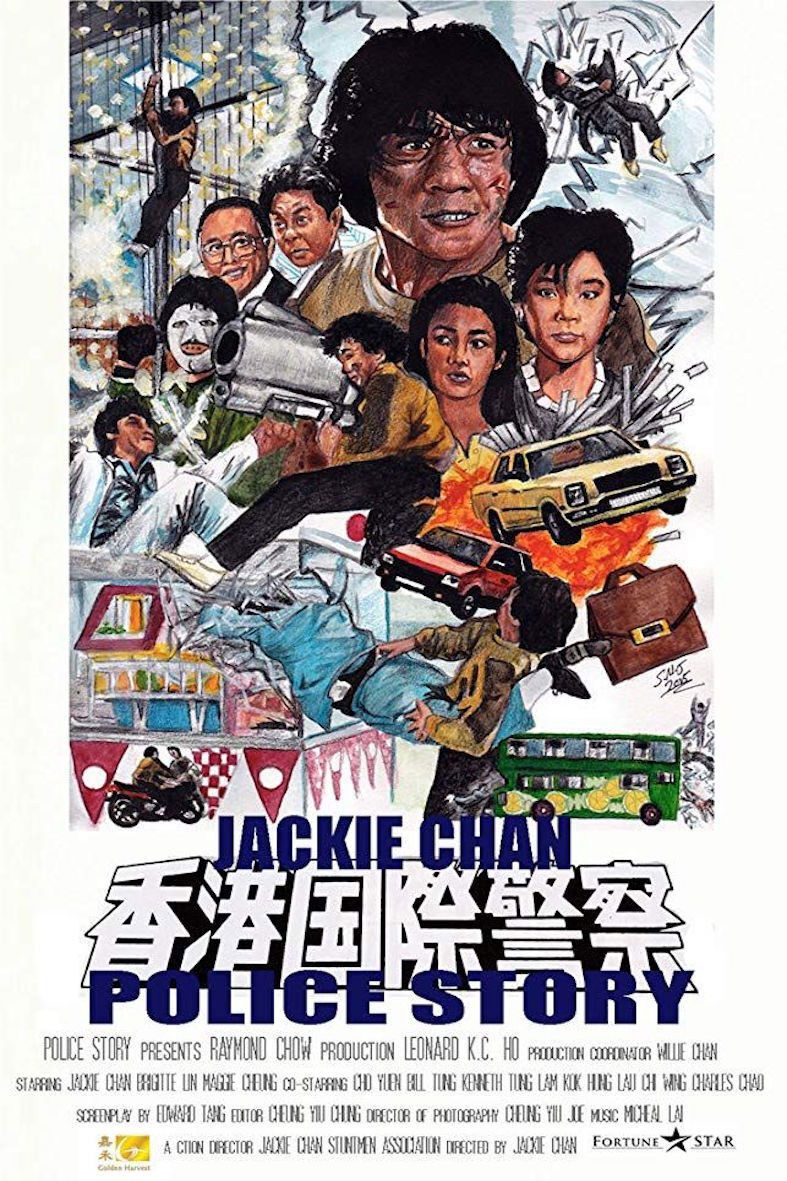
There are movies I admire as a stunt professional and movies that make me want to quit, and Police Story is both at once. Jackie Chan wrote, directed, and starred in this 1985 film as a statement piece, fresh off a miserable Hollywood experience making The Protector, where an American director treated him like a generic tough guy and shot his fights like he was anybody. Police Story was Chan coming home to Hong Kong and showing the world what happens when nobody tells him no. The result is the founding document of modern urban action cinema, and also a film where you can watch human beings get genuinely, legally, contractually injured in nearly every reel. We are never getting another one of these, and as someone who has filled out risk assessment paperwork, part of me says good, and the rest of me grieves.
The opening sequence alone would headline any other film's career. A police operation in a hillside shantytown goes sideways, and Chan stages a car chase straight down through the village, vehicles smashing through actual occupied-looking shacks on a real slope, bodies scattering, and then caps it with the double-decker bus gag, where Chan hangs off the speeding bus by the hook of an umbrella. The famous behind-the-scenes detail is that when the bus brakes hard and the stuntmen fly out through the upper windows, they were supposed to land on the trailing car and instead overshot onto pavement. Watch the finished film and you can see it happen. They kept the take. That's the whole ethos of this production in one shot: the camera rolls, the bodies pay, the audience wins.
Then there's the finale in the shopping mall, which the crew reportedly nicknamed Glass Story because of how much of it everyone went through. From a choreography standpoint it's Chan's team at full power, fights flowing across escalators and display counters, every prop weaponized, every fall finding the hardest available surface. Stuntmen crash through glass panes thick enough that the gags caused real injuries, and the rhythm of the whole sequence builds like a drum solo. The capper is the pole slide, Chan leaping from a railing onto a pole wrapped in live light strings and sliding several stories through exploding bulbs into a glass kiosk below. He burned his hands badly and injured his back doing it, did it essentially in one committed take with multiple cameras, and that shot is now studied the way film schools study the Odessa steps. I've rehearsed descents one tenth as dangerous with ten times the padding. e
What gets lost under the stunt legend is that Police Story is also just sharp filmmaking. Chan the director paces comedy and mayhem like a musician, including a great extended bit of phone-juggling slapstick at the police station that proves his silent-comedy worship of Keaton and Lloyd was never just talk. The cast is stacked in hindsight: Brigitte Lin, years before her white-haired bride era, plays the reluctant witness Chan's character must protect, and a very young Maggie Cheung plays his long-suffering girlfriend May, taking falls herself that no future Cannes darling should have been anywhere near. The film swept up Best Film at the Hong Kong Film Awards, which mattered, because it announced that stunt-driven popular cinema could be respected as cinema.
Historically, this is a hinge point for the whole industry. By 1985 the period kung fu picture was fading, and Police Story moved the fight to the contemporary city, mixing cop thriller plotting, slapstick, and large-scale practical destruction into a formula Hong Kong would ride for a decade. It cemented the Jackie Chan Stunt Team as the most fearless unit in the business, launched a franchise that ran through Supercop and beyond, and established the end-credits outtake reel as a signature, the injuries shown to the audience like receipts. Hollywood spent the next twenty years strip-mining this film. Whole sequences of nineties and two-thousands American action are direct homages, and filmmakers from Michael Bay to the John Wick team have pointed back at it as scripture.
Watching it today, the gender politics are creaky, the plot is a clothesline, and the tonal swings from goofy to genuinely dark take some acclimating. None of it matters once things start moving. Police Story is the purest expression of a philosophy that no longer exists: that the camera should never have to lie, because the performers will simply do the thing. Every CGI-assisted set piece I've worked on since exists in this film's shadow and knows it. Five stars, no hesitation, and a moment of respect for the stuntmen on that bus, who flew past their landing spot, hit the street, got back up, and made history by accident.