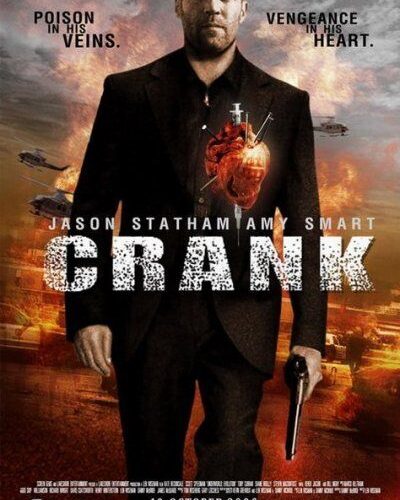
Crank is the action film as video game made literal, a ninety-minute single-life run through Los Angeles in which Jason Statham’s Chev Chelios has been injected with a synthetic Chinese drug that will kill him if his heart rate drops below a certain threshold, and must therefore keep moving, keep fighting, keep escalating through every available stimulant and stressor to stay alive long enough to find the man who poisoned him. Directors Mark Neveldine and Brian Taylor, working under the combined credit Neveldine/Taylor, shoot the film on digital cameras they operated themselves while rollerblading alongside Statham through Los Angeles streets, strapping cameras to wires and RC cars and Statham’s own body, and the result is a film whose visual grammar is as hyperactive as its premise demands. There is no other film that looks like Crank. There is also no other film that would want to.
The plot is a delivery mechanism for the premise’s logic and nothing more, which is the correct artistic decision. Chev needs adrenaline to survive, the city is full of ways to generate adrenaline, therefore the film sequences those ways in ascending order of extremity: a hospital fight, a kitchen confrontation, a Chinatown street brawl, a hotel sequence, the public sex scene that became the film’s most discussed moment, a hospital visit, a helicopter finale. Each set piece is built around a central escalation, and Neveldine/ Taylor execute each one with the efficiency of directors who understand they have approximately eight minutes per beat before the audience’s threshold rises with Chev’s. The Amy Smart character exists partly as a romantic anchor and partly as a choreographic element, a civilian presence that the fight sequences have to route around, and the film uses her with more structural intelligence than its treatment of her on the surface would suggest.
Statham is the load-bearing wall and the review’s most important subject, because Crank is the film where his specific combination of physical credentials and screen charisma found their ideal vehicle. He is a former competitive diver whose body control and spatial awareness come from an athletic discipline rather than a martial arts one, and the way he moves through space reflects that background: efficient, balanced, always aware of where his center of gravity is, which gives even the most chaotic sequences a physical legibility that the camera work is simultaneously destroying. His fighting in this film is not choreographed in any conventional sense; Neveldine/Taylor wanted controlled chaos rather than designed exchanges, and Statham delivers a performance that reads as genuine improvised violence within structured parameters, which is exactly what an elite physical athlete who has been given permission to be dangerous looks like. The distinction between a trained martial artist and a trained athlete in front of a camera is usually visible, and here it works entirely in Statham’s favor.
The technical filmmaking is the element critics most consistently undervalue, because Neveldine/Taylor’s camera work is so aggressive and so deliberately unbeautiful that it reads as raw rather than chosen. It is chosen. The digital cameras they operated personally, following Statham at body level through crowds and streets, produced a POV quality that placed the audience inside Chev’s adrenal state rather than observing it, and the editing, cutting at a rate that mirrors the required heart rate, is calibrated rather than chaotic. The split screens, the digital overlays, the color shifts that accompany each chemical intervention, are all doing specific narrative work: telling you what Chev has taken, how it’s affecting him, how long it’s been since the last dose. What looks like stylistic excess on first viewing reveals itself on second viewing as a fairly rigorous information system, the visual grammar serving the premise’s medical logic with more discipline than the film’s reputation suggests.
Historically, Crank sits at the intersection of several currents that the mid-2000s action landscape was running simultaneously. The Bourne films had established shaky digital immediacy as a prestige register for action cinema, and Neveldine/Taylor took that visual vocabulary and removed its seriousness, using the same tools to generate pure sensory overload rather than gritty realism. The video game structure, a single run with escalating difficulty and a life bar expressed as a timer, reflected the generation of filmmakers who had grown up with games as their primary narrative medium and were now making films that thought in those terms. Statham’s career trajectory is the other historical note worth making: Crank is the film where he stopped being a Guy Ritchie ensemble player and a Transporter franchise lead and became a genuine action star in his own right, a performer with his own audience who would follow him rather than the property, and the character of Chev Chelios is the most purely expressive vehicle his physicality ever found.
The honest accounting: Crank is aggressively uninterested in the audience that needs its action cinema to be about something, the sexual content is as juvenile as the rest of the film is propulsive, and the Amy Smart public sequence is staged with a crudeness that the film’s self-awareness doesn’t fully redeem. Thirty seconds after it ends the film is back to what it’s actually good at, which is moving Chev through Los Angeles at a speed that doesn’t allow for reflection, and the remainder is delivered with a consistency that earns the film’s cult status. Three and a half stars, a permanent recommendation for anyone who wants to understand what Jason Statham is actually built for, and a note on the sequel Crank: High Voltage, which takes every principle established here and doubles it without adding anything new, and which is somehow both more extreme and less interesting, the fate of most sequels that mistake intensity for invention. This is the one. Everything else is a higher dose of a drug that already worked at this strength.